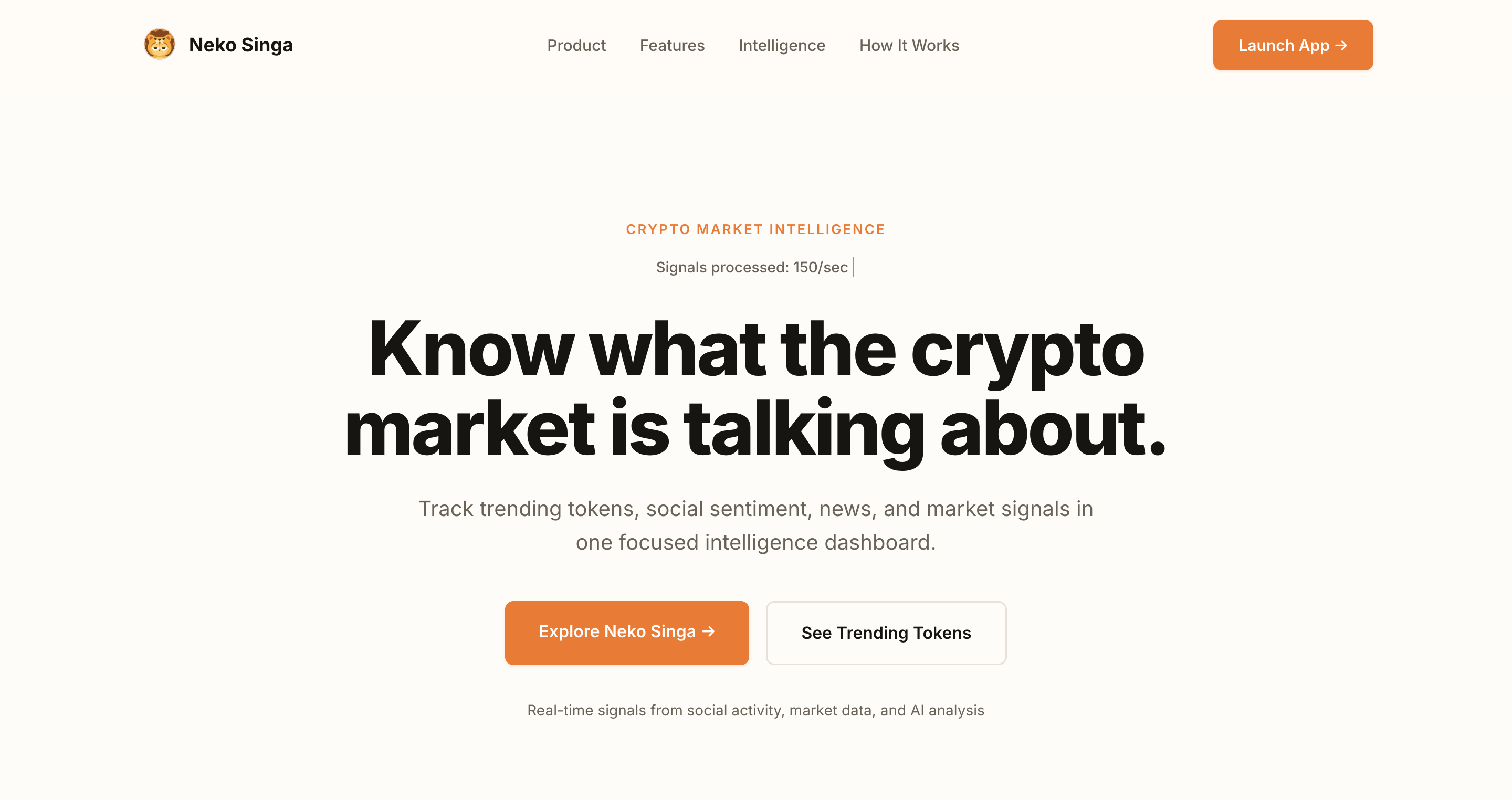
Neko Singa AI
The Problem
Most crypto tools surface raw data and leave interpretation entirely to the user. Price feeds, order books, and wallet trackers show numbers but provide no intelligence on top of them. The Elfa AI full-stack engineer job post described the exact gap: crypto products that help users reason about on-chain data, not just display it. Neko Singa is a direct response to that framing. The question was simple: what if you could just ask?
How It Works
- Users connect their Solana wallet via the Solana wallet adapter. The platform reads holdings without touching private keys.
- A natural language query is sent to a routing layer that decides which agent domain handles it: price monitoring, wallet behavior, or social sentiment.
- Each domain agent fetches the relevant on-chain or off-chain data, then formats it as structured context.
- The structured context is passed to Gemini with a prompt that instructs it to answer the user's question directly, not restate the data.
- If one agent's data source is rate-limited, the fallback chain moves to the next available provider without surfacing the error to the user.
- Responses arrive as clean natural language answers, not tables.
Tech Stack
| Next.js | Fast page loads and server-side data fetching for initial on-chain state |
| Solana wallet adapter | Standard Solana dApp integration, handles multi-wallet support out of the box |
| Gemini API | Generous free tier for development, handles multi-step reasoning in the crypto context |
| TypeScript | Type safety across agent routing and wallet interaction layers |
What I Would Improve
The agent context windows are not shared. When a query spans multiple domains, each agent starts fresh without knowing what another found. A shared context store would make cross-domain queries more coherent. Response latency is also unpredictable when underlying data sources are slow. Adding a streaming response pattern would let partial answers appear while the rest loads, which is a much better UX for complex queries. The sentiment scoring is currently keyword-based. A fine-tuned classifier on crypto-specific language would improve accuracy significantly.
Screenshots